Showing posts with label charity. Show all posts

Friday, April 6, 2012

Give it to Goodwill

We love Goodwill!
Yes, we go to the dump but Gretchen and I love to recycle. Giving to Goodwill  is one of the easiest ways to recycle used clothing and general household items.

Watch this video and learn what Goodwill Does:


Thursday, September 29, 2011

Is that a keepsake? Part 2: Do you like it?

What items do you treasure? A child's treasured keepsake may be a game-winning baseball. Adults have a variety of collections that they treasure.

Antique Camera. Do you like it?
What happens when someone gives you a collection or an item that you do not treasure? Do you like it? You have some choices:
  1. Store it. Do nothing and store it in the garage, attic, or closet.  
  2. Honor it in your home by display. Think of incorporating items into your home decor. There are many options for framing items. 
  3. Honor it in your home by use. Choose a portion of the collection if you are not fond of the whole. If your grandma gave you an entire set of dishes you love, use them! Or, pick out the serving pieces and use them!
  4. Give it away. Give to Goodwill and you give someone a job. Give to a family member that you know would enjoy it for no reason, Christmas or a birthday. 
  5. Sell it - eBay, Craigslist, yard sales, antique dealers, etc.  


Friday, March 18, 2011

Replace, Don't Accumulate!

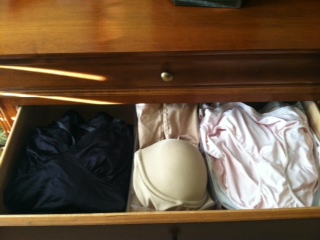
What's in your sock/underwear drawers?
Reclaim space in your sock and panty drawer!
Get in the habit of replacing instead of accumulating.

When you get new t-shirts, socks, underwear, pajamas, or any other piece of clothing, move the old ones out. Challenge yourself to go deeper. If you buy a pack of 6 socks, throw away 7 old pairs. It will be cathartic. 

Remember not to give anything to charity that you wouldn't give to a friend or family member. Please, throw away your socks with holes and any other unmentionables. Nobody really wants second hand intimate appareal.

Sunday, March 13, 2011

It's not that Nasty! Someone can use it? Right?

Take it to the Dump!
If something in your home is nasty, throw it away! Items that are dirty, stained, torn, or broken should not be given to charity. If you wouldn't feel comfortable giving something to a friend or family member, don't give it to a charity either. Throw it away! Furthermore, if you wouldn't feel comfortable with a friend or family member, using something in your home, for instance, sleeping on your ratty sheets, throw them away. If you wouldn't want your doctor to see your toilet seat because it is so stained, replace it, and please, throw the old one away. If the garbage can in your home office is the one you had in your college dorm room and it has decade old chewing gum stuck in the bottom of it, throw it away.

Go through your home with fresh eyes and see what is nasty. If you can't face it, call a trusted, no nonsense friend and let them speak freely about what is nasty in your home. Make a list as you go through your house or follow your friend through you house. Before you go to Target, or Ikea, or Walmart or some other big box store to replace every little nasty thing you threw away, stop and think. Do you really need a trash can in every room? 

Don't replace your nasty electric can opener with a new one. Buy a manual can opener that can be stored in a kitchen drawer, and put in the dishwasher. Swing-away and OXO brands make very good manual can openers.

Really scrutinize what you need to replace. Ask yourself some questions: 
How often is this item used? 
Does this item have a functional place to be stored? 
Can I live without one of these? 
Obviously, the toilet needs a seat, but does the seat need a new fuzzy cover on the lid? NO!

Saturday, March 12, 2011

Storing Warranties, Manuals and Spare Parts

Pile of Warranty Info
Reclaim space in your junk drawers! Rarely is there a need to keep spare parts. If you install a ceiling fan in your home for instance, and parts are left such as a lowering rod or metal plate that covers the spot where the light kit was installed, should you keep those parts? 

Consider that the ceiling height will not change in the room where you installed the fan therefore you will not need the lowering rod and if you installed a light, even if a cover is broken you will most likely replace it or get another light kit.

If you must keep parts after an installation, then put them in an appropriately sized ziploc bag which you have labeled with the name of the item they came from, the room where it is located, and the date.

When you assemble something, if there is an abundance of left over parts, perhaps rereading (or reading for the first time) the directions is a good idea in case you missed a step. Some things do come with extras or accessories or batteries. Store these parts with the manual and/or warranty information together in a large ziploc bag.

Warranties and parts for most everything in your home should have one convenient, accessible location. A cabinet or plastic tub with a lid that can contain all your ziploc bags of parts, manuals and warranties is a great idea. When you buy something, staple the receipt to the warranty or manual and put it with the others. If you get a new thing to replace an old thing, remember to remove the manual for the old thing. The next owner of the old thing, whether you give it to charity or sell it on Craig's list, etc., will be very happy to have it.

You can further categorize warranties and manuals by putting them in pockets or sleeves in a three ring binder. This works especially well for kitchen appliances, both large and small. The next time you need to clean the oven or choose which blade to use to slice potatoes with the food processor, this information can be at your finger tips.

Friday, March 11, 2011

Remove Two Forms of Clutter at Once!

Shopping Bag Clutter
Paper shopping bags are wonderful when reused to purge items to give to charity. 

Larger bags hold games and puzzles, purses, hats or shoes. Toys with accessories can be placed in smaller bags. Small bags are perfect for kitchen gadgets or office supplies. 

Using a shopping bag is more convenient than a box because it has handles. Resist the urge to overfill so the bag won't be too heavy or tear. Several shopping bags fit more easily in a vehicle than several boxes. 

If you have a particular item to give to someone, write their name or the name of the location the item needs to go on the bag. Place the item in the bag and immediately put the bag in the front passenger seat of your vehicle ensuring you will drop it off instead of leaving it in a closet somewhere in your home. Using your accumulated paper shopping bags to give things away removes two forms of clutter from your home at once.

Tuesday, March 8, 2011

Cleaning Out a Closet

Messy Closet?
Cleaning out your closet can be a daunting task. Breaking it down into a few steps can make it less overwhelming. Try the following method seasonally.

Start by separating your closet into two sections. Hang warm weather clothes in one area and cool weather clothes in the other. The next step is odd but really tells the tale. Turn all the hangers around backwards on the rod. Each time you wear something turn the hanger back. At the end of thirty days you will know what you are truly wearing at least for that season.

Take a hard look at what is left on the backwards hangers for the current season. Consider taking what you are not wearing to a consignment shop or donating some items to charity. Consignment shops will want recent styles, in very good condition on hangers. Charities typically do not require hangers or even prefer hangers. Call to check before you toss everything in a bag.

The rule of thumb for donating is if you wouldn't give something to a friend or family member because of its condition, then don't give it to a charity either. Clothing that is stained, torn, or even missing a button will be thrown away. Charities have to pay employees or use volunteers' time to inspect items and then end up throwing a good many of them in the dumpster because of their condition. Charities also have to pay disposal fees for every dumpster they fill. The less a charity has to spend on its operating cost, the more resources it has to fulfill its mission.

After you have eliminated what you are not wearing you can begin to categorize your clothes for that season in a way that works for you. Some people prefer to keep all shirts together, pants, jackets, etc. For women and particularly children, sometimes hanging outfits together is more convenient. You may decide to make an adjustment to your closet system. What matters is determining what you wear most because generally it is what you wear most that looks best, feels comfortable and determines your personal style.